Friday, 22 September
Wealth and decay
 Was planning to go to Athens in the afternoon, but work kept me till 3pm, and so I went to the beach for a pleasant late afternoon -- hardly anyone there, except these two charming kidlets I've been seeing all week with their hats and sunglasses.
 After that, I explored the coves on the west side of Vouliagmeni, passing through a wooded area with defaced "no photography" signs. (Looks innoccuous enough but presumably connected with the military post down the road? ) There's a small beach with a fountain and park, and thatch umbrellas; a couple is playing "racquets" and most everyone else is gone. I venture further through the dried vegetation, following the informal pathways lacing the rocky slopes.
The area is disturbing combination of trash and dog droppings, old buildings left to fall apart in various states of ruin, sitting right next to walled-off wealthy homes and cream-of-the-crop hotels and scenic vistas. From the cliffs, I found the road that leads through an abandonned hillside and eventually comes out near my apartment.There are 20 some small houses, each numbered and set in the trees and each one different from the next, some with spectacular sea views. All of them are rotting away. A polished red firetruck was parked up there, with two firemen hanging out on the porch of one house that looked in slightly better condition.
Vouliagmeni seems to have many open lots and decaying buildings, puzzling in this area of sky high real estate values. I'm told that the church owns large swaths of land, which is suggested by the sign at the foot of the hill -- the words on the right indicate it is an "church orphanage" of the archdioses of Athens, and although the rest of the signs probably say "no entry", well, I can't read Greek, can I?

Saturday, 23 September
Zeus reigns!
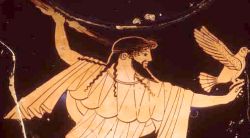
Rolling thunder and torrents of rain woke me at 5:30 this morning. Zeus playing in his backyard. And suddenly, things are looking up: the lightbulb is removed, I've plowed through some grading, made a few papercuts, and best of all, my benefactor has returned and his wireless router is on again. Happiness!
Sunday, 24 September
Pilgrimage to the Acropolis
 Like any good pilgrimage, first there is the journey. I finally got my act together and set out for a day at the Acropolis. Two buses whizzed by just before I reached the stop. During the long wait for the next, a Philippino woman struck up a conversation. She has lived in Greece 15 years, working as a baby nanny. She lives with her 4 sisters on her days off. Every two years she goes home to visit her son and her husband. Her son wants to go to med school, so she has a number of baby-tending years ahead of her in order to finance his education. She speaks Greek, but it turns out she never learned that you can transfer buses using the same ticket. For years she has unnecessarily waited for the express so she wouldn't have to spend two (60 cent) tickets.
Just after we boarded, a man who got on with us came up and said "Quickly, punch your tickets, the inspector is coming." The inspector was already upon us, but fortunately, we had already validated our tickets. The man was relieved, and began talking with us. He grew up in the Vouliagmeni orphanage (!) and comes out from Athens by bus and Metro more than an hour each way to swim at this beach several times a week. It turns out the houses I saw were vacation houses the church used to rent out. The church and stone orphanage are in a different section, and still active.
 We talked all the way into the city. His sons and the grandmother were expecting him for Sunday lunch at 3pm, so he had a few hours to spare, and decided to get off and show me Anafiotika, his favorite area in the old city (Plaka). We climbed up the steep streets to find tiny white houses tucked up against the Acropolis rock wall.
 Carpenters from the island of Anafi built these doll-house-sized "island" houses for themselves before constructing the neoclassical buildings of King Otto of Bavaria's 19th century Athens. (Most destroyed during the ravages of the 20th century wars and archaeology digs.) Tiny little pathways and walls, bright plants, and a strange quiet in the middle of the commotion of the Plaka. Some of them have been repaired, others are dilapidated -- surprising in such a desirable location.
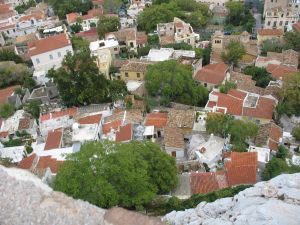 After my kind guide headed home (first offering an invitation for a weekend on an island....hmmm), I checked my bag and headed up the Acropolis, from whence I took this photo of Anafitioka's rooves.
Sunday, 24 September
Ascending the Acropolis

Looking back over the gate and out to sea as you climb towards the top. All the major sights are free on (post-summer?) Sundays, and there were a few Greeks among the tourists (Germans and Koreans win the numbers prize.) Surprisingly there's still a certain wildness to the place - the rough rock, the tumbled pieces, the spectacular 360 view of the plain and the mountains and sea in the distance. To think that water emerges from the rocks all the way up here is remarkable.
 Massive. Silent. Shining. Weathered. Still there. You can see why the Greeks feel passionate about the return of the Parthenon marbles from the British Museum - the building looks scarred and incomplete without them.
The top is a vast construction site - cranes, bags of cement, construction equipment, scaffolding. There are stacks of building pieces everywhere, a giant 4-dimensional jigsaw puzzle with pieces sorted but only a fraction put together.

The security guards wear everyday clothes; when a boundary is crossed or a flash goes off, they blow a whistle or say something, but are unobtrusive. People wander around the buildings and walls as they please. I didn't see no smoking signs, but after I left I realized I hadn't seen a single cigarette butt on the stones up there. Remarkable. There were few ropes, and no noticeable signs (in any language I know anyway) telling you what was forbidden or required. What a contrast with Philadelphia's barricades, crowd control, slick signage, and pervasive uniformed security presence at Independence Hall, another "birthplace of democracy" monument.
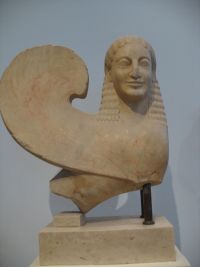
 Even without the Elgin Marbles, the small onsite museum had stunning sculptures and reliefs. To think that 2500 years ago, artists were able to create such magnificent work: the anatomical detail of the bulging muscles, the sheen of the marble, the beautiful individuality of faces and poses. It's the first time I've really felt the excitement that propelled the Renaissance artists and philosophers to think about the human form and human existence in a new way. (Its ironic that Greece itself never went through that Renaissance and Enlightenment period.)
I came down reluctantly, glad that I could come again, and walked around the park at the base of Areospagus, the windy hill. There were south Asian men in groups of 2 or 3 wandering the paths and soon I saw a plastic tiny packet change hands between them and some Greek young men. Hmm, perhaps I should retrace my steps back to the main pathway.
 The Agora at the foot of the Acropolis was the public center of ancient Athens. Rockefeller money has faithfully replicated this main meeting hall from about 150 B.C.E. It looks terribly white and perfect, but it gives you an idea of what these places were like when they were new. I graded papers on the wooden benches, warmed by the late afternoon sun.
 I made my way across the lattice of foundation ruins and water channels to the other side of the Agora, where the temple of Hephaestus still stands, more complete than any of the others, and beautiful in its proportions. Its anonymous architect also built Sounio, which you will see photos of in Week 5 when I finally get them posted.
 Ate a light supper at the foot of the Acropolis in an outdoor café. Eggplant and yoghurt salad, spanakopita, "turkish" coffee. Grading more papers and admiring the juxtaposition of ruins and grafitti again. Then I strolled the Plaka at dusk, wending my way through tourist vendors and cafe tables to the main square.
On the way home, my companion this time was a professor from Norway whose father loved Greece and named her Helenia. She brings students here often. When she first visited the islands in the 60's as a young teenager, "something came into my heart", she says. We have a long conversation because we misunderstand that the express bus is only going part way at this late Sunday hour, and it takes us a while to un-strand ourselves from the bus overnight parking lot. But I'm not in a hurry, and eventually we make our way back.


 Visit the rest of Jenny Beer's