The last 2 weeks were spent grading a mountain of papers and quizzes, tying off loose ends. I ducked out for 3 days to travel to Arahova and Delphi. More on that below.
And I managed to attend folk dancing each week. The group was quietly welcoming, and the teachers were awesome. I didn't need to understand any of their language to read their movement. However, by the end, I was picking up key Greek words: right, left, stop, do-it-again, foot, hand, 1,2,3,4,5,6,7 & 8!, Ready and! What a pleasant way to learn a language.
It was a gift to be able to experience a new and ancient place for two months. Working with a new group of people jostled my habits and challenged my stale ways of thinking. I stepping out the door each morning to see such a *different* landscape and hear the quiet lapping of the waves on the beach. I thank ALBA for welcoming and supporting me. It was an experience I'll always remember with pleasure. EfHaristo!
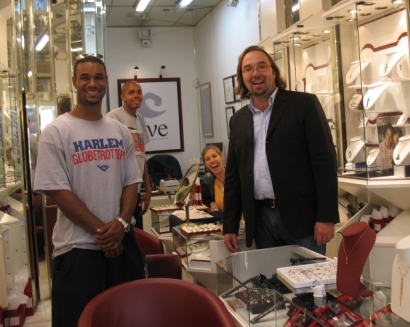
Shopping for jewelry in the Plaka at "Eve's", a shop run by an American/Greek couple who are friends with ALBA staff. Two players from the Harlem Globetrotters stopped by to get something for their moms for Christmas. "EVERYBODY who's ANYBODY" comes through these streets on their way to the Acropolis", say the proprietors. They asked me to take photos.

When capitalism and the church want the same space...
.....Skip all this talk and go to the photos.
I decided to visit Delphi on my one free weekend, and no sooner had I uttered the wish, two of the ALBA staff got on the phone and made all the arrangements for me. Very nice of them! It made the trip a lot easier.
Finding the bus station was a bit of a challenge -- turned out later that there was an unofficial and unlabelled stop near the subway so I wouldn't have had to wander through blocks of tiny streets. However, I'd left myself lots of time, and got on in time.
The bus goes north out of Athens, then after an hour turns eastward across a vast plain. The fields were lined with cotton ripe for harvest and other vegetable crops. After another hour or so, we could see Mt. Olympus through the distant clouds.
When we got to Arahova, the ski resort town on an outcropping near Mt. Olympus, the bus took 45 minutes to negotiate about 8 blocks -- stone houses and stores lined the one street along the cliff edge, and when two tour busses had to pass, everyone sucked in their breath, the drivers' helpers went out to clear the way, and the bug-eye like mirrors on the busses passed within a centimeter of each other. Slow motion drama.
The hotel was just outside of the town on the road to Delphi, with a lovely view down the ravines. The skiiers were hoping for snow -- but this was still mid-October in a globally warming climate, and there were only a few guests staying in the place. I had breakfast with one, a Dutch woman who leads hikes; Greece is her favorite place to take a group walking or hiking. She clued me in to the unlabeled paths that traverse the hills above the town and temples of Delphi.
Arahova was humming with visitors and residents, young and old; the tourist shops and local cafes were full, the food good. Stone houses crowded the steep back alleyways (how do they drive these in icy winter?). Here and there a few older one were crudely built, and gave an idea of the rough poverty that probably characterized the village during the times when no one paid tribute at Delphi anymore and outdoor tourist sports hadn't been invented.
Saturday morning, the fog was so thick, I couldn't see the parking lot beneath my balcony. Oh well, only one day to see Delphi, rain or shine. I took the public bus 9 miles down the road. As we were climbing down from the bus, a young Chinese woman asked me if I was visiting the ruins, as she didn't know where she was going. I allowed as how I didn't either, but I'd looked at the map and at the scenery driving through town, and had a plan. A physicist studying in London, she had left an Athens conference and hopped the bus for a day's sightseeing, but couldn't persuade any of her companions to come with her. She ended up joining me for 6 hours of sightseeing, which made the day much more enjoyable.
The rain did dampen clothing and shoes a bit, though I had my new Athenian folding umbrella (made in China). But it also created fantastic landscapes, and ensured that most tourists had stayed away for the day. I got to exercise my German and French evesdropping on varous bored and wet looking tour groups, but was generally glad to be uninformed and wandering about experiencing the scale and silence and ruin of the place. The size of the outdoor gymnasium and the stadium was suprising. How in pre-train eras did Greeks gather several thousand people high up on a mountainside which is a significant distance from any town? That the patriarchal temple of Apollo and the surrounding buildings that held the treasures of the big city states were now reduced to heaps of stone I actually found a cheering thought (Ozymandius: Look on my works, ye Mighty, and despair! ). In thinking about the guards who had to hang out full time in this remote village protecting these treasuries and probably fighting and stealing from each other for entertainment, I thought no wonder the Greeks invented athletic competition and training -- kept these guys busy. This of course is entirely my own imagining. I have no idea if that's what really happened.
The pictures are better than the stories, so I'll quit now, and just say that it was a nice getaway, and gave me a sense of life in the mountains in Greece, since before that I'd only seen Athens and life by the sea.

 Visit the rest of Jenny Beer's